Showing posts with label cancer. Show all posts

Friday, November 15, 2013

My two cents after two years: part two

Cancerness.

This word doesn’t really exist or have a true definition, but it seems to encompass all qualities that are related to cancer. 

The inherent cancer parts of cancer.

There are so many facets to cancer in general.  Each kind of cancer has its own persnickety descriptions and terminologies.

For example, I can tell someone I had cancer.

If that person asks what kind, sometimes I will respond: blood cancer.

If that someone wants to know the specific blood cancer, I respond: Non-Hodgkins Lymphoma.

If someone wants to know the staging, I can add that it was Stage 1/e Non-Hodgkins Lymphoma.

If I really want to get detailed, I’ll throw in extra descriptors: Stage 1/e Mediastinal (Diffuse) Large B-Cell Non-Hodgkins Lymphoma

See?  So many fancy names and descriptions.

My oncologist did not specifically tell me the fancy terminology outside of Stage 1/e Non-Hodgkins Lymphoma.  It’s possible that he didn’t feel the need to be that specific.  I found out the information in pieces by gazing at my medical records, conversations with doctors at my oncology office and those at MD Anderson, and of course research.

As a future librarian, I’m part of a group of people that will venture forth with the following philosophy: knowledge is power.  It’s pretty much ingrained in the ideology of librarianship, but even outside of librarianship, it’s a giant dose of truth.

However, I have one piece of advice about personal research regarding medicine: take it with a grain of salt.

It’s incredibly easy to be caught up with WebMD, anything produced by the National Institutes of Health (NIH), and the millions of forums and blogs out in cyberspace.

All of it will scare the crap out of you.

I mean this with no sense of irony as I write a cancer-related blog.  I mean this in complete sincerity.

When I was first diagnosed, I gleaned as many information sources I could find concerning cancer statistics, especially ones concerning survival rates.

What a mind fuck.

The precious lucid moments I had between treatments shouldn’t have been concentrating on using my graduate student access to research academic versions of Medline databases at my university’s library in order to find prognosis statistics.

I do believe it is empowering to use information sources to understand cancer causes, symptoms, and treatments.

This might be a philosophy encouraged for doctors as well since my doctor even gave me a printout from PubMed Health about Non-Hodgkins Lymphoma during my diagnosis*.

However, to understand medical research is like opening the server room at any IT department: a lot of friggin’ wires. 

I understand this even more since I have been undertaking an Evaluating Information Services course this past semester.

For example, I found out there is a whole code of ethics for research.  I think on some shallow level, I understood this, but one look at this report will tell you that there is no fooling around:


Aside from approaching a project ethically, one has to take into consideration the following: previous research (i.e. undertaking enough reading to make your eyeballs bleed), various research models (i.e. make it so complicated that no one understands what the hell you are studying), and statistical analysis.

Statistical analysis. 

It sounds like a root canal would be more fun, right?

The permutations that can result from various data collected seem innumerable.  If you truly look at data and apply statistical methods to analyze it, there is the possibility that there are no correlations or too many correlations between data sets. 

Considering these concepts in retrospect is illuminating when it comes to understanding cancer research and statistics.  Discovering correlations takes time and skill.  Then to disseminate all the information to a hungry public eager to learn about their potential longevity in the face of treatment is an equally difficult task.

It is humbling how carefully these types of research take place.  It is overwhelming to think that there are so many pieces to take into consideration.

Enough to make me want to shut the hell up about the negative issues with cancer research.

So, one big thought that I’ve been working through these past few years post-treatment:

Take it one day at a time, or better yet, one minute at a time. 

Suffering over what could be or what will come next is not a good solution.  I have experience with this.  Before going through biopsy surgery in August 2011, I tired out my chemo-ridden self with worry:

What if it is still malignant?  I will have to go UT Southwestern and do a stem cell transplant.  What the hell is a stem cell anyways?  I will live in a bubble and no one will be allowed to visit me.  My cats will steer clear of me because I will have done the human equivalent of “control-alt-delete” and smell weird.

And so forth.

Death was also a consideration.  Death tends to swagger around everything we do as people.  The finality of it is heartbreaking (which is an understatement in itself). 

In reviewing survival rates for Non-Hodgkins Lymphoma, the statistics were, I’ll be honest, a bit grim in some areas, but most positive in others. 

I recently completed a Light the Night walk for the Leukemia & Lymphoma Society (LLS) in October.  There were different balloons that the walkers could carry depending on their level of support.  Red balloons went to people who were just plain supporting.  White balloons went to current patients and survivors.  Gold balloons went to people who were walking in memory of someone. 

There were a lot of gold balloons during that walk.

The image began to alter as the walk ran out of red balloons and began handing out white and gold balloons instead, but the initial image of arriving to the walk comprehending this meaning was tear inducing.

It made me more appreciative of how well I was doing, despite the annoying little post-treatment symptoms.

Coming back to the biopsy surgery, I recall having to start the process of training myself not to get too far ahead mentally.

My mind would wander: tomorrow is my surgery…wait, what am I doing now?  I am cooking.  I will concentrate on the boiling water and pull out the necessary utensils to finish cooking.  Hmm, those knives sure are sharp.  I wonder if there will be sharp knives used for tomorrow’s…ok, shut up.  You are boiling water.

I’m learning that this takes practice and cancerness is a lesson in patience.

Moments are singular pieces of time and moments stacked up are life. 

I urge you to look at the moments.


*Note: I just noticed recently from the URL at the bottom of the printout that was given to me that the page was last updated in February 2013.  It’s interesting to see the evolution**.

**Additional note: from a research perspective, it’s beneficial to refer to sources that update regularly.  Otherwise, you might not be getting factual or up-to-date information.  Just some friendly librarian advice.

Sunday, September 8, 2013

My two cents after two years: part one


It’s been two years this month since I finished my last chemo cycle.  I vaguely recall some of the details of that last day.  I don’t remember the exact date, but I suppose I could look it up if I really wanted to know.  It was sometime in early September, that’s all I remember.  I remember it being a bit different than previous chemo visits because I was so determined for it to be over.  I remember counting out the bags of drugs in chronological order as they finished.

Rituximab…over.
Cyclophosphamide…over.
Doxorubicin Hydrochloride…over.
Vincristine Sulfate…thank goodness you’re over.

The last 2 bags were the smallest and took less time to drain into my body.  I think I was sitting up in the chemo chair, gripping the armrests with my music blaring in my earbuds silently repeating some kind of mantra.  It probably went like this:

Almost over.  Almost done.  This is it.  Just a few more weeks of recovery.  Almost over.

When I was unplugged from the IV machine, I remember wishing I could kiss the floor in gratitude. 

In reality, I had done 2 chemo cycles over the clinically accepted number for someone going through treatment for Non-Hodgkins Lymphoma.  The question of a secondary form of treatment didn’t come up until a few months after this moment.

Regardless, I rode the chemo slump following this treatment like a seasoned professional, even allowing myself to take in all the rest I needed so I didn’t exert myself too much.  I was so well acquainted with the process, it felt like second nature.   I knew when I was going to hurt, what day would depress me the most, when I needed an additional Neupogen shot, and when I needed to take a walk.

I was not prepared, however, for the months and now years that followed the treatment.  No doctor prepared me for the aftermath.  I have learned much in these past years and this I will share with you in different parts. 

Physical changes:

When you are going through treatment, you have been loading your body with chemicals, drugs, and radioactive materials.  When you stop all of that, your body will react in its justified way.  It needs to detox and will take it out on you.  Know this: it’s not your fault. 

For me, after the initial elation of finishing treatment, I was cranky and depressed.  I felt aches all over my body that traditional science describes as a “somatic” symptom of the depression.  Despite this, I’ve noticed that I still feel these aches in my bones when the climate changes or when I get sick.  They seem somewhat different from the aches I felt prior to treatment. 

My period went away after my first cycle of chemo and I went through menopausal symptoms.  Once the chemicals were no longer being pumped into my body, my body went back to its form of normalcy and I felt like a prepubescent teenager all over again before my menstrual cycles became regular.  This took almost a year.  My dear husband has seen me through all the emotional turmoil caused by hormones balancing post treatment. 

I gained 25 pounds from cancer treatment.  Most people think that cancer causes people to become waif-like, but that is only from particular forms of treatment or particular cancers.  Some drugs in the past that caused nausea and vomiting almost instantaneously once inside patients are no longer used or are used infrequently.  Also, every type of cancer has a different set of treatments and every individual battling a form of cancer has a treatment plan tailored to him or her.  Cancer treatment is not a one-size-fits all set of plans.  I highly recommend reading The Emperor of All Maladies by Siddhartha Mukherjee for historical information pertaining to this.  It’s a fascinating history on how doctors figured out that every cancer is entirely unique.  I gained weight from the steroids I had to take following each treatment.  I have since lost 15 of the pounds I gained.  Unfortunately a sign of Non-Hodgkins Lymphoma is rapid weight loss, so I lost the weight slowly and deliberately, so as not to concern my doctor.

My stomach and digestive system were a mess after treatment.  Chemo basically kills everything in your body, including healthy bacteria needed in the digestive system.  I had to take probiotics and ate yogurt to restore the needed bacteria.  This took a few months to begin feeling a bit normal.  Also, since I’m a bit unique with a lack of gallbladder, my liver took the brunt of flushing out all of the toxins.  This resulted in many anguished trips to the toilet to say the least.  I won’t elaborate; you get the idea.

My immune system has been weakened, but I have some physical signals that help me cope.  For example, I work in a public library, where there is usually at least one sick person who visits a day.  I still wash my hands after bathroom trips, before eating food, or after touching something in the library that seems germ-ridden.  However, I’ve learned that washing my hands before going home has helped considerably.  A 30+ minute drive from work to home allows ample opportunities for depositing germs onto the wheel of my car, my face, or even ingesting them when I munch on a much-needed snack.  I can tell that it helps because I don't feel the following symptoms as much as before.  The days when I feel a bit flushed and slightly achy seems to be a warning to me that I need to rest and let my immune system recalibrate.  These signals haven’t failed me in the last couple of years.  This isn’t to say that I haven’t been sick a few times, but I’ve avoided some major illnesses or bodily distress by paying attention to these signals. 

It would seem more holistic for cancer treatment to include some information regarding the side effects of chemo and radiation during the cancer recovery period.  Sure, I've seen my doctor post treatment multiple times, but that has been for bloodwork, port flushes, and PET scans.  My oncologist is making sure I don't get cancer again.  I'm making sure that I feel better and get stronger after the whole process.

I hope that in writing some of these things down, it will be helpful for those going through their own cancer recovery stages or witnessing someone else go through this.

More thoughts to be continued in part two...

Wednesday, July 10, 2013

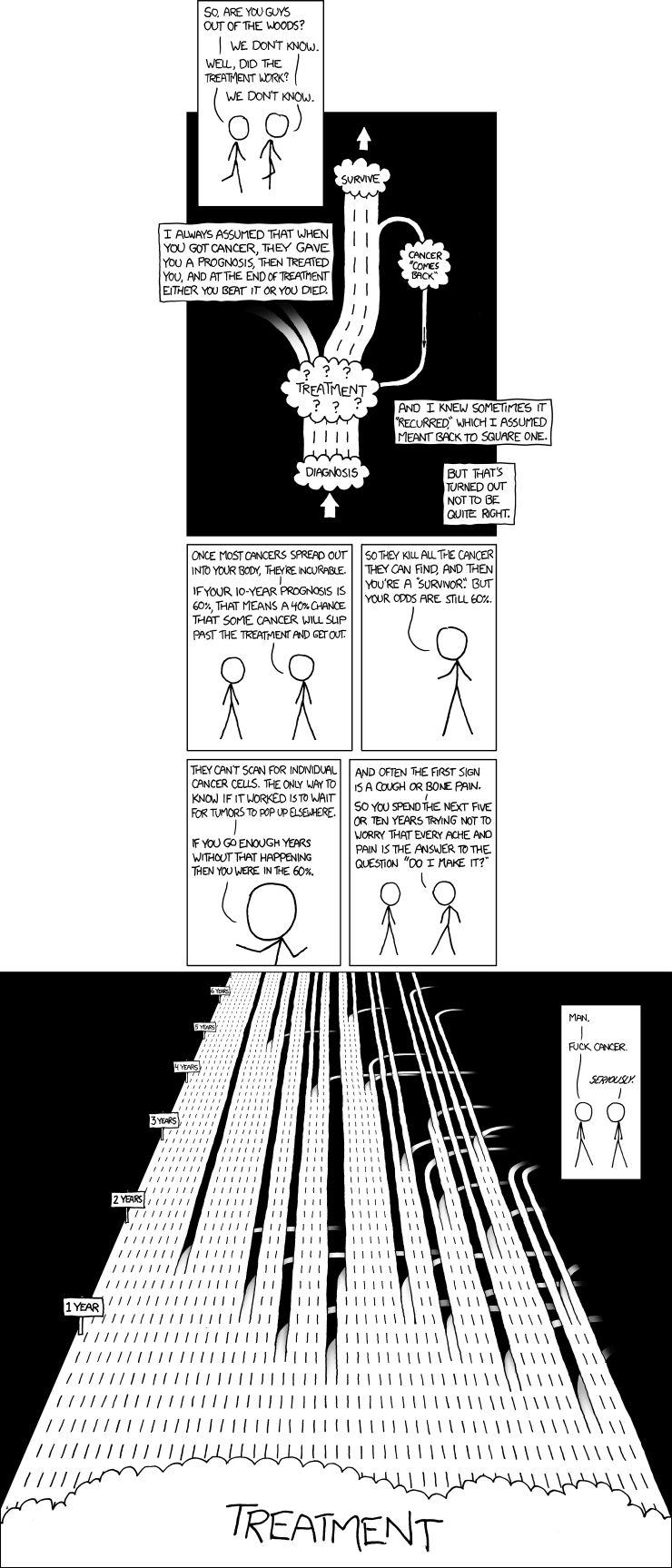
xkcd

This is one of my favorite xkcd comics about cancer.  This pretty much sums up post-treatment paranoia.


Sunday, May 5, 2013

Small but mighty.


Warning: if you are squeamish about blood or blood tests, you might reconsider reading this post.

“Small but mighty” was the name I gave my “good” vein on my right arm this past Wednesday when I did the voluntary biometric screening for my employer.  I always have plenty of information concerning my red and white blood cells, but I figured it couldn’t hurt to learn more about my glucose, cholesterol, and all those other important numbers that seem to infiltrate anyone with entirely fused bones (aka: 27 years of age and older).  Since my own medical hysteria is aligned with someone possibly twice my age and with the allure of a half price recreation center membership, I figured why not hear a professional tell me that I’m overweight, right?

After checking in, a form is handed to me that asks existential multiple-choice questions such as: what do you do when you feel angry? Or, how often do you experience stress?

I turn it in and wait in line to have my blood pressure checked and BMI calculated. After that, I wait in line to have my blood drawn for the other labs.  This is when I inform the nurse that I have a “small but mighty” vein in my right arm.  She feels it and nods saying that helpfully she can get it to rise.  She ties the tourniquet around my arm and hands me a rubber ball that I begin to squeeze.  She feels it and thinks it is good to go.  I take a breath and she inserts the needle.  A few moments later she says: “I don’t know if ‘small but mighty’ is working for you today,” to which I pause, take another breath and tell her it will be one moment.  Sure enough, it begins to flow into the tube.

I always look away, but I generally know what’s going on.  It is strange to be so intimately acquainted with my own veins.  I used to hate blood tests.  Well, I mean, I don’t think anyone enjoys having their blood drawn, but I was one of those patients that needed to lie down and my jaw would shake from nervousness.  Having blood cancer was bad coincidence served on a platter in front of me.  I had to suck up (pun intended) the blood test thing pronto once the treatments started.  

The vein in my right arm, actually, no longer has feeling from the number of times something has been stuck in it.  I have a tiny little brown line on it from the number of times it’s been poked, though it had surprisingly remained unused for a couple of months.

A few weeks before the biometric screening, I had an incident at my oncologist with the phlebotomist who I like a little bit less each time I go there.

This phlebotomist has drawn my blood a few times, but she was not a believer about my “small but mighty” vein.  She felt my right arm and decided to forego it because it felt like a “nerve”.  I tried telling her that, in reality, whatever nerve was near it was damaged, but she wouldnʼt hear me out.  She tried my left arm instead, which I knew with the tiniest bit of smug satisfaction would not work.  

I canʼt really complain too much because she didnʼt want to cause me pain.  She tries my left arm and sure enough, the twisted vein won’t cooperate.  I’m holding pressure on it with gauze, once she’s removed the needle, waiting for a bandage as she is looking down at my hands. She has me run my hands under hot water to bring the veins in my hands to the surface.

I grimace.

She had done this to me before, drawing blood from my hand, and it dripped out so slowly, I thought an entire moon cycle had passed.

I was good, though, and followed her instructions. After inspecting my hands and deciding my right hand was better, she put a tourniquet on my right wrist to make the veins rise to the surface. She then proceeded to put the needle between two knuckles and it hurt so badly, expletives nearly made it out of my mouth.  She sees the look on my face and says, “ok, two tries is all I get” and pulls the needle out, much to my relief. I then rub my hand and say, “canʼt Melissa [the chemo nurse] get it out of my port?” and they decide they will ask.

A few minutes later, I have cotton and tape on my left arm and right hand, and Iʼm led to a patient room to wait for my doctor.

When my doctor comes in, he looks at my bandages and assesses rather astutely, “apparently, they had trouble getting blood out.” I nod. “Why donʼt they just take it out of your port each time?” “I donʼt know,” I respond, “they usually take it out of my arm despite the port.”  He shakes his head slightly.

The sensation of having blood drawn from my mediport is a bit disorienting, despite the nice lack of arm violation.  It does indeed feel like something is being sucked out of my chest.  I always get a bit woozy and I make a face at the color of the blood in the vials once it’s over.  Clearly the port is attached to something going to my lungs, rather than away, because the blood that is drawn is always a dark, almost purple, red color.  It looks viscous and fake.

I mention the mediport to the nurse at the biometric screening and she responds: “oh yeah, definitely easier than the arm,” as she is writing my name on the labels on the vials.  “However, sometimes it requires de-clotting medicine if done a lot.”

“De-clotting medicine?” I ask.  I’m not familiar with this concept.

“It’s the same medicine given to patients who are having other heart or clotting issues.  It’s basically a blood thinner, but it goes directly into the port, which is relatively simple, but not a ton of fun.”

I shiver a bit.

Maybe relying on my “small but mighty” vein was a good thing after all.

Now, I don’t have to think about the next blood test until June.

I am thanking my lucky vein.

Saturday, February 23, 2013

Not perfect, but it'll more than do.


It has occurred to me that my cancer story lacks a postscript.  

Last I left off, I was doing business development in a retail environment.  I had decided to stop school because my job was becoming far too stressful.  

Much has ensued in the previous months.  So much that it seems ridiculous to recount it, but when I think back, I believe there was a purpose to taking a break from writing.  Once I was diagnosed and going through treatment, I found myself isolated and internalizing the majority of my emotions.  My main outlet was writing out my thoughts and this greatly protected me from having the reality of cancer bash me in the head.  

Instead, I have spent the past months recounting my survivorship.  A friend of mine had cautioned me once (having been a young adult that went through cancer herself): some people tend to focus on their cancer survival and it prevents them from moving on with their lives.

I took this to heart, but even now, I sometimes find the awkward inclinations to bring up my cancer.  I suppose the fact that I’m still in the period of time, post-treatment, when cancer recurrence is most likely isn’t helping my case.  I find myself less concerned about dying and more frustrated that if my cancer came back, I might be kicking and screaming to the hospital.  Perhaps I was more brave when I was going through all the tests and treatments because I didn’t know any better.  If I had to do it again, I don’t know exactly how I’d react.  

I get uncomfortable now when I have to go back to my doctor for blood work, port flushes, and PET scans.  It’s confronting a past I don't necessarily want to remember.  I know there is a good reason for the doctor visits and I feel lucky, oddly enough, that I get checked routinely.  However, I find myself with symptoms akin to PTSD for the strangest of triggers.  I’m already nervous about having the surgery to remove my port even though that is about a year away.  I’m tired of being a pincushion, a science experiment, a life in precarious balance.

Health-wise, there isn’t too much to report, but it is interesting the things I’ve discovered in the post-treatment months.  I’m still having some cognitive issues including forgetting memories and losing my train of thought often.  It is somewhat rare when I don’t feel like I’m in some kind of fog.  I've learned to gracefully recover from these moments and many people tell me they don't notice anything.  I've had to take precautions to adapt to these changes is all.  I jot down, possibly, more notes than necessary, especially daily tasks.  If I don't make it stupid easy for myself to remember, I'll just lose the thought.  

Aside from the minor cognitive impairment, off and on, I’ll notice some neuropathy in my fingers and toes.  Days where the air is damp or when the weather is changing means my bones ache.  I cannot tolerate alcohol like I used to and fear my poor liver has become damaged with my lack of gallbladder and taking the brunt of filtering out chemo chemicals.

I had a recurrence scare last summer where a PET scan didn’t come back crystal clear, sending me on another road trip to MD Anderson to check in with the radiation oncologist I met the year before.  She looked at the results and found nothing of concern, just some pesky radiation remnants.  My mom and I had walked into the main building of MD Anderson with purpose and I looked around at the children and adults in the lobby obviously going through treatment.  My hair had mostly grown in by this point and I don’t think I looked like a former cancer patient.  I empathized with them but in my head silently repeated a mantra along the lines of: I will not be doing this again, I will not be doing this again, I will not be doing this again....

I recognize that cancer recovery is tough, but I also recognize it is a life path that is mimicked in a variety of circumstances.  I find myself becoming more and more comfortable in my skin. 

The balance in my life might be precarious, but it has become strengthened from many external sources: my soon-to-be husband, my new job, the satisfaction of returning to school, my friends and family.

I see myself writing in the future and my post-treatment recovery thoughts will be reflected in a more positive light.

Stay tuned...

Monday, June 6, 2011

Cancer zen

Chemo creates bouts of uncertainty, but there are times when there is clarity, even in their singular moments.

There are times when I feel like I should be telling people: I’m fine, now save yourself. Somehow I feel like a ghost that has drifted into the background. This is by no means because of how people treat me, it’s just how the cancer makes me feel reflective.

There are days when I don’t feel well and I am motivated to move forward for the pure sake of finding inner peace. I liken it to standing on one foot and trying to stay balanced. Sometimes you have to focus on a spot on a wall just to stay upright. I try to work through the discomfort just to find that spot within my mind.

There are days when it feels like I’m freefalling backwards and I don’t know if the feeling will stop. I don’t know if something will catch my fall or if I’ll just get the breath knocked out of me when I land.

Maybe those bouts of uncertainty?

Today at my oncology center, they were holding a Cancer Survivor’s Day. I received a goodie bag with a t-shirt, some candies, and a Livestrong rubber bracelet. They also provided food and refreshments.

I recall they hung posters and signs in the chemo room and lab advertising the day, but honestly, I had forgotten until the day had arrived. I was merely showing up for a blood test. It was like a real party, complete with people who knew each other and had connected in the past. These were people who were on a first name basis with the doctors and nurses.

I felt so out of place.

While everyone at the oncology center knows me and knows about me, my age differentiates me from many of the patients.

I breeze into the hospital for my appointments, still in my work clothes, walking faster than most of the healthy people in the hallways. If it weren’t for the bare head or head wrap, you probably couldn’t tell that I was a cancer patient at first glance.

Today at the little event, I noticed that I was not just years, but decades, younger than my peers. It’s a contradictory feeling, seeing people older than middle age and elderly battle cancer. There’s a bit of a stigma that cancer happens to the elderly more than other age groups. Perhaps this is true statistically. However, it doesn’t make it any easier to watch someone older than me go through cancer. I’m sure the same could be said for the reverse.

Like the woman sitting next to me at the event today noshing on food. She was probably the first stranger who wanted to know my cancer situation and understood about the treatments. When I was leaving, she held my hand for a moment and said: “you stay strong sweetie.” It felt so odd, someone who is probably a grandmother, saying that to me.

One of the nurse technicians pinned a yellow ribbon on my sweater and gave me a couple of yellow roses.

I left the hospital with the roses in my bag, feeling a bit like a rejected prom date, ever aware and uncertain about my situation.

The thing I didn’t understand about the term “cancer survivor” before having cancer is that it is used even while someone is in treatment. The idea is that the moment you are diagnosed, you are surviving cancer.

A giant portion of the uncertainty is the midpoint PET scan, which has come and gone. I should find out the results later this week. I’m nervous and anxious about the fate of the monster in my lung.

Next week is also yet another chemo. Part of me thinks: didn’t I just do chemo? Maybe the last rounds of treatment will seem faster. In a blink, summer will be over.

Meanwhile, there is more time to work on my cancer zen.

Saturday, May 28, 2011

Happenstance

I very much believe that things happen for a reason.

However, if I were to say that there is truth and understanding in this bout of cancer shenanigans, I’d be kidding myself.

I don’t know why it happened.

What am I truly expecting out of my life? I don’t think I have too many preconceived notions about where it will take me. I’ve always been very academically mindful, but I never had this checklist for things I should accomplish. I mean, there have been the “it would nice” and the “I’d like to” moments. However, I knew early on I didn’t need that hanging over my head.

Maybe this has been my saving grace. Honestly, thus far, my life has been exceptional. People I care about, who care back, surround me. I’ve traveled to other countries. I completed a college degree in something that drove my artistic vision and I’m working on another. I was born into the most wonderful family possible.

I doubt I’d recommend other people get cancer, as if it were this free-floating amorphous disease you could just inhale accidentally. Then again, wait until researchers discover the causes behind lymphoma and I could be eating this statement.

I have the desire and drive to move beyond this, despite the marks it has left on me both literally and intellectually. I suppose I’ve finally discovered that as much I look forward, I need to work on my situation now.

Thus begins a new beginning to my spiritual journey. Sitting there in the chemo room, I allowed my body to just rest and sleep. Before, I’d squirmed and just hated being there and feeling awful. I have found a new resolve. Part of it is because I don’t think I have much of a choice. My doctor thinks the mass should be gone by now. I was surprised to hear this news. My initial thought was: why the hell are we doing more treatments?

Apparently, the other 4 treatments are to ensure the cancer doesn’t come back. The bad cells could potentially be floating around my body still. Part of me is encouraged, but also discouraged by this news.

I found a punching bag in my sister’s old closet and I’ve pulled it out to not only work out my upper arm strength, but to get my aggression out. I now take a walk twice a day on my days off and in the evenings on workdays.

I’m determined to keep myself strong as I go forth into the treatments that will make me weak.

I could philosophize all day, but perhaps this is why all this has happened: to get my mind, body, and spirit to become a singular entity.

Or at least to let me hit a punching bag with zeal.

Monday, May 16, 2011

The fishbowl

I was suspicious that I had been feeling so great after my third chemo and held my breath for the week following the treatment. Like clockwork, I began to feel awful. I’ve dubbed this the 6th day, 6-day slump. It seems to be around the 6th day post treatment, the chemo rollercoaster has finished its climb and is ready for the drop.

I would like to think this drop could be considered thrilling, but really it could be placed in the “I’d rather face-plant into concrete” category. As an added bonus, it lasts more than a few days.

There is a bright side, thankfully, and it is that the week following this hellish slump gets better. I get to feel less nauseated, with fewer headaches, and my muscles will not have a revolution.

While I wait for this slump to pass and for the brighter days to come into view, I have much time to ponder simple things, such as:

How come I can fall asleep in a warm bath, but am wide-awake within warm blankets?

Or, what will make me less nauseous: corn flakes with milk or toast with butter?

Still, the vague irony is that the nicest days seem to be the ones where I am committed inside.

This North Texas spring has been the mildest I can remember and beckons us to come outdoors. My outdoor excitement these past few days has been getting the mail and absorbing as much Vitamin D as I can, before I regret walking outside in my pajamas in full view of the neighbors.

As of late, my body in full Revolutionary mode, complete with its own Boston Tea Party, and dumping contents into the sea (let me not get more explicit than this).

I am either a glutton for punishment, or there is truly nothing on television, because I watch Food Network even during these times. Trip to the toilet and then: Oh! Cupcake Wars is on! How does someone make 1,000 cupcakes in 2 hours?

I am saddened that my existence has been homogenized by generic questions such as the above. I reflect upon a time when I was working two jobs and going to school. I recall reading school material with zeal. Now, the same zeal has been applied to maintaining hydrated and a preoccupation with blood cell counts and body temperature.

For some reason, I still like to cook when I feel awful, even if I don’t eat the food. For example, today, the war continues and I still found satisfaction in creaming together butter and sugar.

Perhaps all these things are a way to bide my time before the upcoming 4th chemo treatment and the tests that will follow to see my progress.

Part of me is anxious to see how much the mass has reduced at the halfway point and the outlook for the duration of my summer.

Thus, distractions and revolutions ensue.

Orange pound cake, anyone?

Monday, May 2, 2011

Chlorophyll vs. Cancer


Photo: Mimo trying to steal some cucumber skins during my juicing operation.

The last few weeks have been green. Green thumb and green juice. I’ve entered the forays of green living. And we all know what Kermit says.

Prior to finding out I had cancer, I had picked up Kris Carr’s Crazy Sexy Diet, a book that gives kudos to drinking copious amounts of green juice and having a mostly alkaline diet. It was my initial plan to begin adhering to a stricter diet in order to feel better. Part of me thinks that perhaps I knew something was wrong prior to my diagnosis.

Even though my doctors told me before beginning chemo treatments that I wouldn’t have to change my diet, I knew better.

With large amounts of chemicals entering my body, releasing large amounts of toxins, I understood that a certain amount of detoxification had to occur.

I had already attempted to cut out caffeine beginning last autumn. Coffee was like a spiteful, but charming, ex that kept tempting me back. I would break my ritual of non-coffee drinking with an excuse to keep myself awake, but immediately regret it with a pounding headache and racing heart.

It was like experiencing my week of coffee withdrawal in one guilt-laden sip.

Since my hospital stay, I’ve stuck with herbal tea, and the occasional green tea, if I want a beverage choice outside of juice and water.

The only time I am around coffee now is when I use the grounds (from the local Starbucks) for my new compost pile.

In finding a project that preoccupies my time and attention, I’ve turned to gardening. So far, it’s been nothing overly fancy, as I had limited knowledge on keeping plants alive with previous attempts. However, with research from both online sources and library books, I’ve become a lot more informed on keeping plants happy and healthy. Currently in my container garden there are some flowers, given to me from friends in the hospital. There are 7 herbs: lavender, basil, boxwood basil, cilantro, lemon mint, sweet mint, and parsley. I also found a Roma tomato plant already producing fruit. Days later, I went to a Dallas nursery and picked up a satsuma tree.

I think I have an addiction. A few more plants or trees and I could quite possibly become Crazy Plant Lady.

Since I cook quite a bit with fresh vegetables, the compost bin is filled with cooking scraps. The hope is that the compost will be ready in the late summer or fall when I’m ready to begin planting for the spring. I’ve ordered a catalog from the Seed Savers Exchange to pick out some heirloom varieties to grow this year into the next. I would like to grow some of the things that go into the green juice that I now consume first thing in the morning. It’s a mixture of cucumber, kale, broccoli, apple, and ginger, and frankly tastes green.

Nothing like swirling emerald green juice in a mason jar and taking it with you to work to scare people.

Then again, it’s the ultimate showdown: chlorophyll vs. cancer.

I hedge my bets on the green stuff.

Friday, April 22, 2011

The cancer card

I don’t think anything quite prepares someone to hear the word “cancer” dropped into normal conversation. This is especially true for conversations involving someone you know. It’s as if someone has turned off the music and turned on the lights. Everything that appeared glamorous suddenly seems cold, distant, and isolating.

Depending on the party involved, there isn’t always a good way to vocalize your feelings because you are just stunned. It’s easy to think in panic: cancer doesn’t happen to someone I know, it happens to other people.

It all becomes very real, very quick.

Now on the other side of it, I notice how even in my own speech patterns, I can’t always bring myself to say “cancer”. It’s interesting to see how many euphemisms can be substituted for the word. Further, sometimes I feel like a jackass if I flit around the truth. Sometimes I feel like a jackass when I have to use “cancer” as an explanation.

I have noticed that there is a certain amount of grace necessary to navigate cancer as a term.

Cancer is a loaded word. It’s an identity. It contains memories and flashbacks, thoughts and feelings. It’s an association and a description. In day-to-day vocabulary, we all know it has a negative connotation.

When I’ve used the word, the variety of reactions hardly astounds me. Sometimes it’s greeted with hopeful grimaces. Sometimes pity. Sometimes, brushed off and not even acknowledged, like I’ve just informed the person that I have a paper cut: “oh, that’s too bad”.

Each of us deals with the cancer bomb a different way, but when it goes off, it smells like fear and dread.

It’s sad that as a society, because of what it represents, cancer is an explanation of its own. As I’ve been navigating issues related to working, school, and finances, using the cancer card has had its benefits. In a small way, it’s nice that the majority of people understand, and they don’t require me to explain why I feel a certain way a certain time of day.

By no means do I want to use the cancer card to make other people feel bad or to get my way (see the jackass comments above), but there are times when it’s the only description that is adequate.

As in, I’m not trying to be a pain in the ass: I have cancer.

When I go to my oncologist, I see other patients and it’s amazing to me that you can tell who has been touched or traumatized by cancer. Sure, there are visual cues, like missing hair, but it’s in their eyes.

It’s remarkable how they don’t look sad, just resigned to what is happening, at peace about their progress, and hopeful about their fate.

Rarely do I see anger and it’s the compassion I feel from other patients that gets me choked up. It makes me want to be stronger for not only myself, but my cancer peers as well.

No one wants to sign up for cancer voluntarily. But, perhaps holding onto the cancer card isn’t so negative and awful as we perceive.

Tuesday, April 12, 2011

This is your brain on chemo

In 1998, there was a memorable Public Service Announcement for a Drug-Free America starring Rachael Leigh Cook in which she smashed her way around a kitchen with a frying pan demonstrating how drugs affects lives. I doubt the line “any questions?” has ever been said with such memorable authority.

No doubt there were dozens of PSAs that I’ve managed to remember over the years, some of which still have influenced me.

Note: if you lived in California in the early 90s, you will recall a water shortage due to severe drought conditions. There were days when you were to “shower with a friend,” which believe it or not wasn’t an effort created by the porn industry. There was also the PSA in which a little kid is brushing his teeth and leaving the water faucet on while doing so. The camera cuts to a fish in the ocean, with the ocean water level going further and further down before cutting back to the kid who is still carelessly letting the water faucet go while brushing his teeth.

This PSA created a harbor of water conservation paranoia in me since then.

Recalling PSA comparisons of splattered fried eggs to drug-addled brains, I cannot help but see a connection to my own current state.

It is a mildly humorous thought that chemicals and narcotics are drained and fed into my body under the guise of shrinking a lung mass and killing off mutated cells.

Aren’t these the things that people would do recreationally that we’ve been told our entire lives not to do?

In completing research about the side effects of chemotherapy, there is one phenomenon called “chemo fog,” which also includes a few other terms including “chemo brain.” Essentially, there is a lack of mental clarity when undergoing chemo, which includes short-term memory loss, difficulty in remembering details, lack of multi-tasking skills, feeling disorganized, forgetting words, and just “spacing out” (see this link for other fun facts).

The scarier part about this phenomenon is that doctors do not understand why this occurs.

Let’s review.

We are not surprised that hitting one’s head in an accident could possibly cause cognitive impairment or irreversible damage to the brain. However, it’s unknown why there is a lack of lucidity after pumping a human with toxic chemicals that are killing off cells, including healthy good ones?

Perhaps in my own chemo fog, I find this concept ludicrous: a big fat “duh”.

So, have I experienced any of the effects of “chemo fog”? The answer is a resounding yes. Or, let’s just say, if there were a time for blonde jokes, this would be it.

I feel like myself but off.

Not remembering the day of the week? I blame it on chemo fog, not sheer laziness.

Writing things down in my day planner because appointments come into my head, don’t process fully, and then float back out? I call it a good habit for a brain that doesn’t want to hold as much anymore.

Going downstairs for something, then forgetting what it was, going back upstairs, remembering, and then going downstairs again? Chemo fog AND exercise.

According to The Chemotherapy Survival Guide by Judith McKay and Tamera Schacher, a theory is that “chemotherapy can cause direct toxic injury to brain cells.” This book is an interesting resource and even includes a chapter with a section devoted to chemo fog. While it’s not a comforting topic, it’s a positive step that researchers are devoting time to finding ways to prevent cognitive impairment due to chemotherapy.

So, remember kids, don’t do drugs (unless the doctors specifically instruct you to do so). Many cells within our bodies reproduce, but brain cells are the highfaluting bastards that just want to keep to themselves, not reproduce, die alone, and leave you cognitively stranded.

If Rachael Leigh Cook was doing a PSA for “chemo fog,” she’d thrash around the kitchen with a frying pan, but she’d then misplace the pan and forget what she was doing.

This is your brain on chemo.

What was I supposed to do Friday again…?

Postscript: You might be wondering how I can write all these blogs without sounding like a Neanderthal. Since I’m a library student who writes research papers, I’m a stickler for good prose. With my own “chemo fog,” I review my writing multiple times to ensure that what I say makes sense and is structured in an orderly manner. I even complete them first in MS Word, then copy and paste the words into a blog posting. Admittedly, there are times when I publish one, I’ll review it and find flaws. Call me a perfectionist, but this is how I function.

Statistics

Note: This is a small selection of material I have found in researching Non-Hodgkins Lymphoma and all my sources are cited at the bottom.

Statistics and notations, specifically causal or relational ones, for Non-Hodgkins Lymphoma are not lengthy or descriptive. The information scientist in me is not satisfied with this information, so I’ve been doing some digging.

According to Frederick Hagemeister, M.D., professor in the Department of Lymphoma and Myeloma, in MD Anderson’s Fall 2010 Network newsletter:

“We’re not yet sure, but we suspect that some forms of lymphoma may have a genetic disposition, not in terms of inheriting the disease, but perhaps in inheriting a type of immune deficiency, for example. Other possible causes include environmental factors, such as exposure to pesticides and herbicides, and certain viruses, although these causes are rare.”1

I already understand that in order for cancer to occur, you need just one mutated cell to duplicate and the domino effect lets loose.

My doctor and general collective cancer intelligence all say not to prioritize time in discovering what causes cancer. In my professional life, I enjoy finding out answers for patrons and customers. What would make my own situation any different?

Non-Hodgkins Lymphoma is a fairly common type of cancer in the United States. According to the Leukemia and Lymphoma Society, Non-Hodgkins Lymphoma is the seventh most common type of cancer.

For patients with Hodgkins Lymphoma, the number of incidences in adults between the ages of 20-34 and those above the age of 65 are higher than for the adults between the ages of 35 and 64.

However, for patients with Non-Hodgkins Lymphoma (like me), the rise of incidence appears almost exponential with age. From 2003-2007, for adults between the ages of 25 and 29, there were 330,000 cases of Non-Hogkins Lymphoma, which is a small percentage compared to the millions of cases for adults ages 75 and older. 2

According to MD Anderson:

“Over 66,000 adults and children will be diagnosed with non-Hodgkin's lymphoma this year. Over 95% of those cases will be adults around 60 years of age. Men have a slightly higher risk than women, although the numbers of women being diagnosed with non-Hodgkin's lymphoma has recently been increasing. Non-Hodgkin's lymphoma is more common in whites than African Americans or Asian Americans.”3

Part of me looks as this information and thinks I must be in a very small percentage of incidences. I would be in the 5% of adults not around 60 years of age. I am female, though while the numbers are increasing, women tend to have a lower risk than males. I am technically 5/8 white, with the remainder of my ethnic background as Asian and Native American, populations that have a lower risk of developing Non-Hodgkins Lymphoma.

As an interesting family history side note, there are no known cases of cancer on my father’s side of the family. On my mother’s side of the family, there are incidences of cancer, but it’s not prevalent.

I refuse to blame something authentic or arbitrary as the reason I have cancer. However, if I have a genetic predisposition to getting cancer or have an immune system deficiency, I want to know how this will affect my future. If, in fact this was caused by environmental factors, what are they? Are there people like me who could use this information as prevention?

I know that much research exists in discovering the causes behind Lymphoma, especially Non-Hodgkins Lymphoma. I know I won’t be able to add anything extraordinary to this research. For my own information curiosity, I’m collecting all the puzzle pieces in my own medical and personal history.

There is a small amount of paranoia I feel: will this come back after all the treatments are complete? If it is a genetic disposition, can I pass this onto my children (assuming I can even have children after all this)?

I can’t shake off the concept that my future has irrevocably been altered. However, I don’t want to look at it like a bad thing. I look at it as an opportunity to get more tools to keep living the life I want. I might or might not be a statistic, but I truly believe things happen for a reason. With all the sad and terrible things that happen in our daily lives, this seems like a futile belief. I think that sometimes you have to find the proverbial light at the end of the tunnel. Sometimes you have to make your own sunshine.

If you surround yourself with positive thoughts and wonderful people, what could go wrong?

1 MD Anderson Fall 2010 Focus on Non-Hodgkins Lymphoma
2 The Leukemia & Lymphoma Society Facts 2010-2011
3 MD Anderson Non-Hodgkins Lymphoma Patient Information

Monday, April 11, 2011

Everyday is (almost) the same

I begin each morning by taking my blood pressure, checking my blood-oxygen level and pulse, and finally my temperature. I created a table that allows me track all the numbers. I separate the day numbers with yellow cells and the night numbers with blue cells (because they look pretty).

I take a medication to help with stomach acid in the morning and one to maintain my uric acid in the evening. I have a slew of “as needed” medications. They sit in a small green bucket in the front hall. It’s like having my own pharmacy. Post chemo, there are more required medications to take, but the minimum is required for this week.

Keeping track of the pills is a bit unnatural for me. I had entered the hospital as someone who never took a daily medication, to someone who has a typed list with the hard-to-pronounce names, dosage, and milligrams. Also on the list are the chemotherapy drugs I receive.

I have utter insomnia and usually do not fall asleep until between midnight and 2 am. I typically wake up between 4 am and 6 am to use the toilet because all fluids move through me quickly. Then again, supposedly it’s a good thing, because it means I’m hydrated.

I don’t cough as much as I used to, which is a relief. I have a system of how I organize the pillows on my bed so that I can fall asleep comfortably and not cough in the middle of the night and wake myself up.

Even my cat has integrated his lifestyle with his newfound home, since I had to move back in with my parents. He hasn’t quite made friends with the other family cats and spends his nights in my bedroom. He mews pitifully at the other cats seemingly saying: “hey, I’m a nice guy!” Alas, they still run away and hide from him.

I had a giant sigh of relief after the doctor’s appointment prior to my upcoming 2nd chemotherapy. I’d been waiting for the results of my bone marrow biopsies and PET scan. I’ve also had my blood monitored every other day with the antibody injections and had watched my white blood cell count go from high to low back to high again throughout the week. The lab results handouts sit in small stack on my desk. They are the visualizations of me in blood cell form.

My body is finally maintaining a good percentage of white blood cells. My bone marrow biopsies came back negative, so I have no dormant cancer cells hiding out there. The PET scan indicated that I have cancer isolated in my lung. I'm grateful that in relative terms, this is a fairly straightforward cancer to treat.

Part of me is humored by the fact that I’m based on blood cells, numbers, and chemicals. The doctors look at the stuff that is being pumped into me and coming out of me.

In doing my own research about my particular cocktail of chemotherapies, I’ve discovered that I have the aggressive form of Non-Hodgkins Lymphoma, but I was not necessarily informed of this. I suppose I just knew it was important to get treated right away. I recall asking my doctor how long I had this mass in my lungs and he seemed to think only a few months. Considering its size, I was a bit shocked with this information. However, with lymphoma, aggressive forms are not necessarily bad. In fact, with the aggressive subtypes of lymphoma, chemotherapy can typically cure the cancer. Indolent (slow moving) types are difficult to monitor because it’s not always known how or where it will grow.

My particular cocktail of chemotherapy is affectionately named “R-CHOP”. To me, it sounds like something a pirate butcher might exclaim. It’s a weirdly cute abbreviation for a toxic chemical mixture.

The letters stand for the names of the drugs used in the treatments. For example, the "R" is Rituximab (Rituxan), which is used first before the other drugs to help the immune system. This was the drug that was first administered to me in the hospital, where I was monitored so closely by a nurse. I await this same mixture in the upcoming week for my second chemotherapy.

It’s still amazing to me that I had gone from girl with a cough to girl with cancer in little over a week. Though, time has flown by relatively quickly. Each day holds a different challenge. Just after my first chemo, it was getting out of the bed. This week, it’s unpacking my belongings and being with friends since I’m feeling better than I had prior to going to the hospital. I’m a bit nervous about the next chemo since I know I won’t be feeling so well after it’s done.

All in all, I’m just taking it one day at a time.