Friday, November 15, 2013

My two cents after two years: part two

Cancerness.

This word doesn’t really exist or have a true definition, but it seems to encompass all qualities that are related to cancer. 

The inherent cancer parts of cancer.

There are so many facets to cancer in general.  Each kind of cancer has its own persnickety descriptions and terminologies.

For example, I can tell someone I had cancer.

If that person asks what kind, sometimes I will respond: blood cancer.

If that someone wants to know the specific blood cancer, I respond: Non-Hodgkins Lymphoma.

If someone wants to know the staging, I can add that it was Stage 1/e Non-Hodgkins Lymphoma.

If I really want to get detailed, I’ll throw in extra descriptors: Stage 1/e Mediastinal (Diffuse) Large B-Cell Non-Hodgkins Lymphoma

See?  So many fancy names and descriptions.

My oncologist did not specifically tell me the fancy terminology outside of Stage 1/e Non-Hodgkins Lymphoma.  It’s possible that he didn’t feel the need to be that specific.  I found out the information in pieces by gazing at my medical records, conversations with doctors at my oncology office and those at MD Anderson, and of course research.

As a future librarian, I’m part of a group of people that will venture forth with the following philosophy: knowledge is power.  It’s pretty much ingrained in the ideology of librarianship, but even outside of librarianship, it’s a giant dose of truth.

However, I have one piece of advice about personal research regarding medicine: take it with a grain of salt.

It’s incredibly easy to be caught up with WebMD, anything produced by the National Institutes of Health (NIH), and the millions of forums and blogs out in cyberspace.

All of it will scare the crap out of you.

I mean this with no sense of irony as I write a cancer-related blog.  I mean this in complete sincerity.

When I was first diagnosed, I gleaned as many information sources I could find concerning cancer statistics, especially ones concerning survival rates.

What a mind fuck.

The precious lucid moments I had between treatments shouldn’t have been concentrating on using my graduate student access to research academic versions of Medline databases at my university’s library in order to find prognosis statistics.

I do believe it is empowering to use information sources to understand cancer causes, symptoms, and treatments.

This might be a philosophy encouraged for doctors as well since my doctor even gave me a printout from PubMed Health about Non-Hodgkins Lymphoma during my diagnosis*.

However, to understand medical research is like opening the server room at any IT department: a lot of friggin’ wires. 

I understand this even more since I have been undertaking an Evaluating Information Services course this past semester.

For example, I found out there is a whole code of ethics for research.  I think on some shallow level, I understood this, but one look at this report will tell you that there is no fooling around:


Aside from approaching a project ethically, one has to take into consideration the following: previous research (i.e. undertaking enough reading to make your eyeballs bleed), various research models (i.e. make it so complicated that no one understands what the hell you are studying), and statistical analysis.

Statistical analysis. 

It sounds like a root canal would be more fun, right?

The permutations that can result from various data collected seem innumerable.  If you truly look at data and apply statistical methods to analyze it, there is the possibility that there are no correlations or too many correlations between data sets. 

Considering these concepts in retrospect is illuminating when it comes to understanding cancer research and statistics.  Discovering correlations takes time and skill.  Then to disseminate all the information to a hungry public eager to learn about their potential longevity in the face of treatment is an equally difficult task.

It is humbling how carefully these types of research take place.  It is overwhelming to think that there are so many pieces to take into consideration.

Enough to make me want to shut the hell up about the negative issues with cancer research.

So, one big thought that I’ve been working through these past few years post-treatment:

Take it one day at a time, or better yet, one minute at a time. 

Suffering over what could be or what will come next is not a good solution.  I have experience with this.  Before going through biopsy surgery in August 2011, I tired out my chemo-ridden self with worry:

What if it is still malignant?  I will have to go UT Southwestern and do a stem cell transplant.  What the hell is a stem cell anyways?  I will live in a bubble and no one will be allowed to visit me.  My cats will steer clear of me because I will have done the human equivalent of “control-alt-delete” and smell weird.

And so forth.

Death was also a consideration.  Death tends to swagger around everything we do as people.  The finality of it is heartbreaking (which is an understatement in itself). 

In reviewing survival rates for Non-Hodgkins Lymphoma, the statistics were, I’ll be honest, a bit grim in some areas, but most positive in others. 

I recently completed a Light the Night walk for the Leukemia & Lymphoma Society (LLS) in October.  There were different balloons that the walkers could carry depending on their level of support.  Red balloons went to people who were just plain supporting.  White balloons went to current patients and survivors.  Gold balloons went to people who were walking in memory of someone. 

There were a lot of gold balloons during that walk.

The image began to alter as the walk ran out of red balloons and began handing out white and gold balloons instead, but the initial image of arriving to the walk comprehending this meaning was tear inducing.

It made me more appreciative of how well I was doing, despite the annoying little post-treatment symptoms.

Coming back to the biopsy surgery, I recall having to start the process of training myself not to get too far ahead mentally.

My mind would wander: tomorrow is my surgerywait, what am I doing now?  I am cooking.  I will concentrate on the boiling water and pull out the necessary utensils to finish cooking.  Hmm, those knives sure are sharp.  I wonder if there will be sharp knives used for tomorrow’s…ok, shut up.  You are boiling water.

I’m learning that this takes practice and cancerness is a lesson in patience.

Moments are singular pieces of time and moments stacked up are life. 

I urge you to look at the moments.


*Note: I just noticed recently from the URL at the bottom of the printout that was given to me that the page was last updated in February 2013.  It’s interesting to see the evolution**.

**Additional note: from a research perspective, it’s beneficial to refer to sources that update regularly.  Otherwise, you might not be getting factual or up-to-date information.  Just some friendly librarian advice.

Sunday, September 8, 2013

My two cents after two years: part one


It’s been two years this month since I finished my last chemo cycle.  I vaguely recall some of the details of that last day.  I don’t remember the exact date, but I suppose I could look it up if I really wanted to know.  It was sometime in early September, that’s all I remember.  I remember it being a bit different than previous chemo visits because I was so determined for it to be over.  I remember counting out the bags of drugs in chronological order as they finished.

Rituximab…over.
Cyclophosphamide…over.
Doxorubicin Hydrochloride…over.
Vincristine Sulfate…thank goodness you’re over.

The last 2 bags were the smallest and took less time to drain into my body.  I think I was sitting up in the chemo chair, gripping the armrests with my music blaring in my earbuds silently repeating some kind of mantra.  It probably went like this:

Almost over.  Almost done.  This is it.  Just a few more weeks of recovery.  Almost over.

When I was unplugged from the IV machine, I remember wishing I could kiss the floor in gratitude. 

In reality, I had done 2 chemo cycles over the clinically accepted number for someone going through treatment for Non-Hodgkins Lymphoma.  The question of a secondary form of treatment didn’t come up until a few months after this moment.

Regardless, I rode the chemo slump following this treatment like a seasoned professional, even allowing myself to take in all the rest I needed so I didn’t exert myself too much.  I was so well acquainted with the process, it felt like second nature.   I knew when I was going to hurt, what day would depress me the most, when I needed an additional Neupogen shot, and when I needed to take a walk.

I was not prepared, however, for the months and now years that followed the treatment.  No doctor prepared me for the aftermath.  I have learned much in these past years and this I will share with you in different parts. 

Physical changes:

When you are going through treatment, you have been loading your body with chemicals, drugs, and radioactive materials.  When you stop all of that, your body will react in its justified way.  It needs to detox and will take it out on you.  Know this: it’s not your fault. 

For me, after the initial elation of finishing treatment, I was cranky and depressed.  I felt aches all over my body that traditional science describes as a “somatic” symptom of the depression.  Despite this, I’ve noticed that I still feel these aches in my bones when the climate changes or when I get sick.  They seem somewhat different from the aches I felt prior to treatment. 

My period went away after my first cycle of chemo and I went through menopausal symptoms.  Once the chemicals were no longer being pumped into my body, my body went back to its form of normalcy and I felt like a prepubescent teenager all over again before my menstrual cycles became regular.  This took almost a year.  My dear husband has seen me through all the emotional turmoil caused by hormones balancing post treatment. 

I gained 25 pounds from cancer treatment.  Most people think that cancer causes people to become waif-like, but that is only from particular forms of treatment or particular cancers.  Some drugs in the past that caused nausea and vomiting almost instantaneously once inside patients are no longer used or are used infrequently.  Also, every type of cancer has a different set of treatments and every individual battling a form of cancer has a treatment plan tailored to him or her.  Cancer treatment is not a one-size-fits all set of plans.  I highly recommend reading The Emperor of All Maladies by Siddhartha Mukherjee for historical information pertaining to this.  It’s a fascinating history on how doctors figured out that every cancer is entirely unique.  I gained weight from the steroids I had to take following each treatment.  I have since lost 15 of the pounds I gained.  Unfortunately a sign of Non-Hodgkins Lymphoma is rapid weight loss, so I lost the weight slowly and deliberately, so as not to concern my doctor.

My stomach and digestive system were a mess after treatment.  Chemo basically kills everything in your body, including healthy bacteria needed in the digestive system.  I had to take probiotics and ate yogurt to restore the needed bacteria.  This took a few months to begin feeling a bit normal.  Also, since I’m a bit unique with a lack of gallbladder, my liver took the brunt of flushing out all of the toxins.  This resulted in many anguished trips to the toilet to say the least.  I won’t elaborate; you get the idea.

My immune system has been weakened, but I have some physical signals that help me cope.  For example, I work in a public library, where there is usually at least one sick person who visits a day.  I still wash my hands after bathroom trips, before eating food, or after touching something in the library that seems germ-ridden.  However, I’ve learned that washing my hands before going home has helped considerably.  A 30+ minute drive from work to home allows ample opportunities for depositing germs onto the wheel of my car, my face, or even ingesting them when I munch on a much-needed snack.  I can tell that it helps because I don't feel the following symptoms as much as before.  The days when I feel a bit flushed and slightly achy seems to be a warning to me that I need to rest and let my immune system recalibrate.  These signals haven’t failed me in the last couple of years.  This isn’t to say that I haven’t been sick a few times, but I’ve avoided some major illnesses or bodily distress by paying attention to these signals. 

It would seem more holistic for cancer treatment to include some information regarding the side effects of chemo and radiation during the cancer recovery period.  Sure, I've seen my doctor post treatment multiple times, but that has been for bloodwork, port flushes, and PET scans.  My oncologist is making sure I don't get cancer again.  I'm making sure that I feel better and get stronger after the whole process.

I hope that in writing some of these things down, it will be helpful for those going through their own cancer recovery stages or witnessing someone else go through this.

More thoughts to be continued in part two...

Wednesday, July 10, 2013

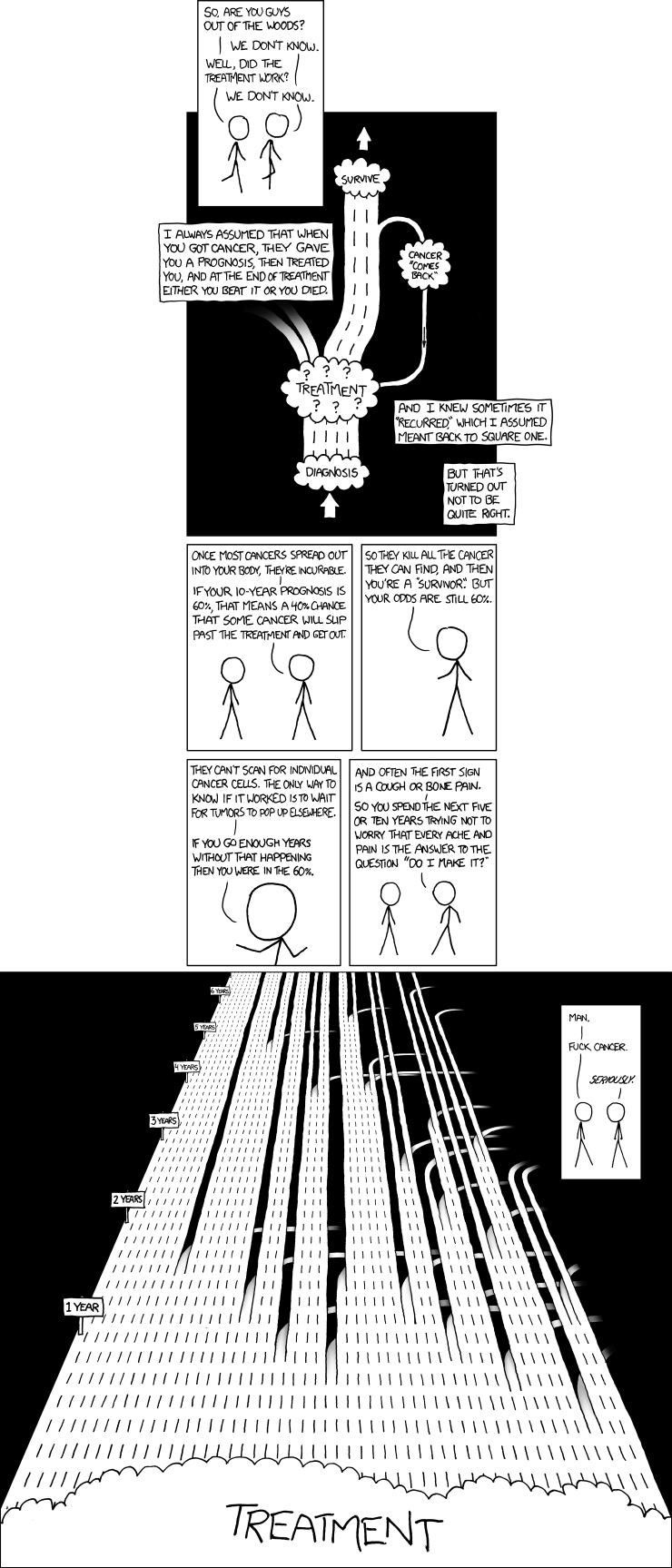
xkcd

This is one of my favorite xkcd comics about cancer.  This pretty much sums up post-treatment paranoia.


Sunday, May 5, 2013

Small but mighty.


Warning: if you are squeamish about blood or blood tests, you might reconsider reading this post.

“Small but mighty” was the name I gave my “good” vein on my right arm this past Wednesday when I did the voluntary biometric screening for my employer.  I always have plenty of information concerning my red and white blood cells, but I figured it couldn’t hurt to learn more about my glucose, cholesterol, and all those other important numbers that seem to infiltrate anyone with entirely fused bones (aka: 27 years of age and older).  Since my own medical hysteria is aligned with someone possibly twice my age and with the allure of a half price recreation center membership, I figured why not hear a professional tell me that I’m overweight, right?

After checking in, a form is handed to me that asks existential multiple-choice questions such as: what do you do when you feel angry? Or, how often do you experience stress?

I turn it in and wait in line to have my blood pressure checked and BMI calculated. After that, I wait in line to have my blood drawn for the other labs.  This is when I inform the nurse that I have a “small but mighty” vein in my right arm.  She feels it and nods saying that helpfully she can get it to rise.  She ties the tourniquet around my arm and hands me a rubber ball that I begin to squeeze.  She feels it and thinks it is good to go.  I take a breath and she inserts the needle.  A few moments later she says: “I don’t know if ‘small but mighty’ is working for you today,” to which I pause, take another breath and tell her it will be one moment.  Sure enough, it begins to flow into the tube.

I always look away, but I generally know what’s going on.  It is strange to be so intimately acquainted with my own veins.  I used to hate blood tests.  Well, I mean, I don’t think anyone enjoys having their blood drawn, but I was one of those patients that needed to lie down and my jaw would shake from nervousness.  Having blood cancer was bad coincidence served on a platter in front of me.  I had to suck up (pun intended) the blood test thing pronto once the treatments started.  

The vein in my right arm, actually, no longer has feeling from the number of times something has been stuck in it.  I have a tiny little brown line on it from the number of times it’s been poked, though it had surprisingly remained unused for a couple of months.

A few weeks before the biometric screening, I had an incident at my oncologist with the phlebotomist who I like a little bit less each time I go there.

This phlebotomist has drawn my blood a few times, but she was not a believer about my “small but mighty” vein.  She felt my right arm and decided to forego it because it felt like a “nerve”.  I tried telling her that, in reality, whatever nerve was near it was damaged, but she wouldnʼt hear me out.  She tried my left arm instead, which I knew with the tiniest bit of smug satisfaction would not work.  

I canʼt really complain too much because she didnʼt want to cause me pain.  She tries my left arm and sure enough, the twisted vein won’t cooperate.  I’m holding pressure on it with gauze, once she’s removed the needle, waiting for a bandage as she is looking down at my hands. She has me run my hands under hot water to bring the veins in my hands to the surface.

I grimace.

She had done this to me before, drawing blood from my hand, and it dripped out so slowly, I thought an entire moon cycle had passed.

I was good, though, and followed her instructions. After inspecting my hands and deciding my right hand was better, she put a tourniquet on my right wrist to make the veins rise to the surface. She then proceeded to put the needle between two knuckles and it hurt so badly, expletives nearly made it out of my mouth.  She sees the look on my face and says, “ok, two tries is all I get” and pulls the needle out, much to my relief. I then rub my hand and say, “canʼt Melissa [the chemo nurse] get it out of my port?” and they decide they will ask.

A few minutes later, I have cotton and tape on my left arm and right hand, and Iʼm led to a patient room to wait for my doctor.

When my doctor comes in, he looks at my bandages and assesses rather astutely, “apparently, they had trouble getting blood out.” I nod. “Why donʼt they just take it out of your port each time?” “I donʼt know,” I respond, “they usually take it out of my arm despite the port.”  He shakes his head slightly.

The sensation of having blood drawn from my mediport is a bit disorienting, despite the nice lack of arm violation.  It does indeed feel like something is being sucked out of my chest.  I always get a bit woozy and I make a face at the color of the blood in the vials once it’s over.  Clearly the port is attached to something going to my lungs, rather than away, because the blood that is drawn is always a dark, almost purple, red color.  It looks viscous and fake.

I mention the mediport to the nurse at the biometric screening and she responds: “oh yeah, definitely easier than the arm,” as she is writing my name on the labels on the vials.  “However, sometimes it requires de-clotting medicine if done a lot.”

“De-clotting medicine?” I ask.  I’m not familiar with this concept.

“It’s the same medicine given to patients who are having other heart or clotting issues.  It’s basically a blood thinner, but it goes directly into the port, which is relatively simple, but not a ton of fun.”

I shiver a bit.

Maybe relying on my “small but mighty” vein was a good thing after all.

Now, I don’t have to think about the next blood test until June.

I am thanking my lucky vein.

Saturday, February 23, 2013

Not perfect, but it'll more than do.


It has occurred to me that my cancer story lacks a postscript.  

Last I left off, I was doing business development in a retail environment.  I had decided to stop school because my job was becoming far too stressful.  

Much has ensued in the previous months.  So much that it seems ridiculous to recount it, but when I think back, I believe there was a purpose to taking a break from writing.  Once I was diagnosed and going through treatment, I found myself isolated and internalizing the majority of my emotions.  My main outlet was writing out my thoughts and this greatly protected me from having the reality of cancer bash me in the head.  

Instead, I have spent the past months recounting my survivorship.  A friend of mine had cautioned me once (having been a young adult that went through cancer herself): some people tend to focus on their cancer survival and it prevents them from moving on with their lives.

I took this to heart, but even now, I sometimes find the awkward inclinations to bring up my cancer.  I suppose the fact that I’m still in the period of time, post-treatment, when cancer recurrence is most likely isn’t helping my case.  I find myself less concerned about dying and more frustrated that if my cancer came back, I might be kicking and screaming to the hospital.  Perhaps I was more brave when I was going through all the tests and treatments because I didn’t know any better.  If I had to do it again, I don’t know exactly how I’d react.  

I get uncomfortable now when I have to go back to my doctor for blood work, port flushes, and PET scans.  It’s confronting a past I don't necessarily want to remember.  I know there is a good reason for the doctor visits and I feel lucky, oddly enough, that I get checked routinely.  However, I find myself with symptoms akin to PTSD for the strangest of triggers.  I’m already nervous about having the surgery to remove my port even though that is about a year away.  I’m tired of being a pincushion, a science experiment, a life in precarious balance.

Health-wise, there isn’t too much to report, but it is interesting the things I’ve discovered in the post-treatment months.  I’m still having some cognitive issues including forgetting memories and losing my train of thought often.  It is somewhat rare when I don’t feel like I’m in some kind of fog.  I've learned to gracefully recover from these moments and many people tell me they don't notice anything.  I've had to take precautions to adapt to these changes is all.  I jot down, possibly, more notes than necessary, especially daily tasks.  If I don't make it stupid easy for myself to remember, I'll just lose the thought.  

Aside from the minor cognitive impairment, off and on, I’ll notice some neuropathy in my fingers and toes.  Days where the air is damp or when the weather is changing means my bones ache.  I cannot tolerate alcohol like I used to and fear my poor liver has become damaged with my lack of gallbladder and taking the brunt of filtering out chemo chemicals.

I had a recurrence scare last summer where a PET scan didn’t come back crystal clear, sending me on another road trip to MD Anderson to check in with the radiation oncologist I met the year before.  She looked at the results and found nothing of concern, just some pesky radiation remnants.  My mom and I had walked into the main building of MD Anderson with purpose and I looked around at the children and adults in the lobby obviously going through treatment.  My hair had mostly grown in by this point and I don’t think I looked like a former cancer patient.  I empathized with them but in my head silently repeated a mantra along the lines of: I will not be doing this again, I will not be doing this again, I will not be doing this again....

I recognize that cancer recovery is tough, but I also recognize it is a life path that is mimicked in a variety of circumstances.  I find myself becoming more and more comfortable in my skin. 

The balance in my life might be precarious, but it has become strengthened from many external sources: my soon-to-be husband, my new job, the satisfaction of returning to school, my friends and family.

I see myself writing in the future and my post-treatment recovery thoughts will be reflected in a more positive light.

Stay tuned...

Wednesday, June 20, 2012

Life? Or Theater?


One of my favorite artists, Charlotte Salomon, posed this question: is it life? Or is it theater?  She made around 800 small gouache paintings depicting her tragic life and secured it in a book.

In 2007, I visited Amsterdam.  I was traveling by myself and staying in a hostel.  It was cheap and clean and cramped.  I shared a bunk bed in a room the size of a large closet with 2 additional bunk beds.  I was the only American and, surprisingly, the oldest traveler.  There was the lone ginger-headed and cheerful Aussie teen girl who slept on the bottom bunk.  There were the Aussie brother and sister sharing another bunk and a young English couple who tittered when I said “cell phone” rather than “mobile”.  Behind their backs, the Aussies called them “the Limeys” in a way that seemed almost affectionate rather than derogatory. 

Charlotte Salomon’s precious book is held in the Jewish Historical Museum in Amsterdam.  When I made my plans to go to Amsterdam, this was one place I had to go.

My hostel was farther into the city and it took 2 zones worth of strippenkart to get to the museum, only to walk a few blocks and find the building composed of multiple old synagogues.  After searching through the religious artifacts, that were symbolic that they survived the Holocaust, I found no sign of Life? Or Theater?

It was only a glance in a corner when I came to the realization that the exhibition was going through remodeling and the book was not in fact on display.  I took a step beyond a velvet rope in hopes to sneak a glance at the book.  I longed to experience its momentum through its mass and size.

It was not there.

Instead an empty glass case only hinted at its former occupant. 

I suppose I could have spoken up and pleaded and asked the museum staff if I could see the paintings since I had come so far to visit it.  But I didn’t.

I picked up a CD of its digitized images in the gift shop.  The middle-aged woman who worked at the gift shop was intrigued by my presence and I could feel her gaze on my back as I looked at postcards: we rarely see young people here.  Even when paying for a bookmark and the CD, I could tell she wasn’t sure what language to speak.  Dutch? Hebrew? English?  She smiled kindly to me when I spoke English, as I only knew a handful of basic Dutch formalities, my Hebrew non-existent.

When I left the museum, I had a tiny bit of disappointment.  I didn’t get to see the famous piece that resonated with me.  I traveled over 5000 miles to see a piece of art that wasn’t there.

In its own trickery and timing, something surfaced within me.  I felt the elusive quality of life’s events.  This was a taste.  A tease. 

Sometimes things just don’t work out.  Sometimes things just don’t make sense.

I ask myself everyday though, not necessarily intending to receive an answer: so what is it then? Is it life? Or is it theater?

Postscript: on this same trip, the Rijksmuseum was also going through remodeling, so I saw little of that one too.  However, the Anne Frank House and the Van Gogh Museum were awe-inspiring.  I also found out recently that the Dutch no longer use strippenkart to take the tram.  It was basically a line of skinny perforated tickets that got stamped with times and then torn off when expired.  It seemed a bit old-fashioned at the time, but now knowing I have unused tickets hiding somewhere in my belongings makes me feel like I have a piece of something historic.

Tuesday, June 5, 2012

Quitter


They say a sign of maturity is when you understand your limitations and follow them.

I have had a humbling Spring to say the least.

I am already all too aware that my body is still in post-treatment flux and is continually evolving to a better state of health.  This evolution, however, is taking its time.  It feels that when I look back to my early 20s, it was decades ago, that I’m looking across a giant bridge at myself on the other side.  I feel aged by circumstance.  Fences run around my once-boundless energy.  I turn a corner to pick up some speed and deter it, but there it is, yet another wall.   

Post-treatment fatigue and joint pain has caused much alarm and frustration for me in the past few months.  When I brought these issues up to my oncologist during one of my follow up appointments last month, he said it might be depression.  Determined to prove him wrong, I began systematically removing items out of my diet that could be the source of the fatigue and pain.

I have quit eating wheat and dairy.  I have quit drinking coffee.  Ok, ok, I haven’t perfected these pristine dietary standards, but for the most part, I’ve been a good girl.  You might think I dove into the sea of the silly.  In reality, desperate times call for desperate desperateness. 

I’m surprised to say that a diet with lean meat and lots of vegetables seems to be the best for me thus far.  Green juice has made its way back to my normal routine.  Part of the annoyance factor is the awareness about the dark sides of the food industry.  It is part government agriculture subsidies, part chemical manufacturing, part marketing and advertising. 

This awareness ties back to the mystery surrounding my initial diagnosis.  It is like everything is bad for you.  Anything can cause cancer.  Better yet, anything can prevent cancer.  To come up with an informed decision is impossible.  Everything contradicts everything else.

Worse still, this cynicism is leaking into other parts of my life. 

Don’t get me wrong, there is more Pollyanna than not within me.  It’s just that my tolerance for bullshit is getting smaller by the day.  Then again, I can be extraordinarily patient with other people, but not with myself.  This, of course, has negative repercussions.

After nearly a year of dealing with school woes: financial aid, student status, withdrawing from classes, registration, getting this and that approved, waiting for replies from the Graduate School and the College of Information about my future graduate career, I’ve come to a significant conclusion:

I’m exhausted.

I’m also exactly where I wanted to be with or without school: I have a job with benefits that can cover my formerly cancer-ridden ass (or should I say lung?) and any potential shenanigans that might ensue.  I have a 401(k) and paid vacation.  I like my coworkers and workplace.

All in all, I’ve become the responsible grown-up despite my cancer-ness.

So, why do I need to pile any additional stress? 

I left work a tiny bit earlier Monday thinking I’d get home early and help my family prepare dinner.  I ended up arriving exactly when I would get there if I hadn’t left early because of an accident on the main highway to my home.

No lies I hate traffic.  I even took off my work shoes while stopped on I-35 and fished some flip-flops out of the backseat.  I had that much time and inclination to get home and be comfortable.

I also had enough time to come to a realization.  If I sit in congested traffic to get home, it is more infuriating than taking the side streets, which may be longer but keep me moving. 

Thus, why the hell am I putting myself in congested traffic when all I need is to take the long way on the side streets?

Upon arriving home grumpy and tired, I knew my decision to stop graduate school was made.

At this point, I don’t know if it will be a permanent or temporary hiatus.  I don’t know if I will stay in librarianship, even though it is dear to my heart.  I don’t know if I’ll return to UNT.

Decisions, decisions…

…for another day.

Saturday, March 10, 2012

A year in review.


I have started and stopped many blog posts since I last wrote.  Nothing quite stuck.  Nothing quite seemed right.

It has almost been a year since my cancer diagnosis. 

There are so many fragments in my memories from this past year.  Some things stand out more than others.  You’d think it is the terrible procedures, treatments, and surgeries I had to experience.

More often, to be honest, I reflect more on the events aside from those.

I am all too aware that I fall back onto my snarky and sarcastic sense of humor.  It’s a defense mechanism that conceals a great deal of hurt, but it has helped ease the blow.  I still swing it over my shoulders and carry it with me day to day. 

I’m surprised almost daily to come across other survivors and friends and family members of survivors.  It’s a bit like joining a club where its members only understand the lingo. 

There is a bittersweet irony of cancer survival.  Yes, my treatment is over and I happy dance over this.  However, I am all too aware of the potentially rocky future I face after the fact. 

There is a fine line between living for the moment and living to preserve one’s self.  Where does spontaneity and relishing the small things fit in?  Do I think for now?  Or do I think for the future?  Is it possible to balance both? 

I have a more formal sense of survival.  Survival not only in health, but also as a global citizen, as an adult, as a perpetual student of life. 

It’s so easy to view the world as cruel, but it is defeatist and all encompassing.  If darkness is the night sky we see, then the moments of clarity, love, and positive thoughts are the stars that punctuate it.  They might seem small and insignificant, but they are everywhere.

I thank my lucky stars each day for the awareness I’ve been granted despite it all.

Thursday, January 5, 2012

Abstract Realism


During the actual radiation, I don’t see anything.  I sorta feel it.  I was told I wouldn’t, but I’m not entirely sure I agree.  Sometimes I swear I smell the scent of burnt popcorn.  I wonder if it’s the tissue in my chest burning. 

I figure the interstellar space around my Deathstar is littered with radioactive poison and remnants of cells.  I imagine them floating like sparkly dust particles in my body.  I wish my brain would allow me to go inside myself and see everything microscopically.  I’m unsure of what it truly looks like in there.  Aside from the initial x-ray with the looming mass overtaking my left lung, I don’t have a good picture in my head of it all.  Perhaps this could be remedied.  My squeamishness has flown out the window after this past year.  I might not enjoy having blood siphoned out of my port for example, but by God, if it necessary, I will just friggin’ deal with it.  Surely looking at photos of my insides won’t incite any additional paranoia.

During radiation, my nose sometimes runs a bit too.  I was told it might hit my esophagus and I could have trouble swallowing.  I haven’t noticed this so much.  The nausea and fatigue hits about 3-4 hours after the treatment.  I get smacked with this narcoleptic exhaustion.  I have to remind myself not to drive my car around 6 at night because I might just collapse.  It usually goes away in about an hour unless I fall asleep first.  If I fight through it, I seem to be okay, but there is a moment or two when all I want to do is succumb to the sweet, sweet sensation of fading away in tiredness.  This is perhaps the only similar sensation I had during chemo: the moments when you just give in and let your body do what it needs.

The fading in and out of my body and consciousness envelops my entire daily existence.  Am I here? 

I recall the sensation of falling backwards.  There was that uncertainty of whether I’d hit something or just keep falling.  I don’t know which is worse: knowing when it will end and dealing with the consequences or not knowing when or if it will end at all. 

This pretty much sums up my feelings on my cancer journey thus far.  The shadows of it are always near me.  I don’t think they will ever go away.  It is an encouraging thought to realize that many before me have gone through this and recovered and living fine, productive lives.  I doubt anyone truly thinks about the processes that people who have had serious trauma go through in recovery.  It can be disheartening to watch someone you care about go through those things.  I still maintain that I think this has been harder for my friends and family than myself.  I know what I am feeling and I know when it is good or bad, but that uncertainty is a mainstay for those close to you.  They can only gauge your reactions, expressions, and words. 

I have this fear that the momentum of my experiences will backhand me so fast I’ll have whiplash.  I have to keep moving one step ahead of it before it reaches me. 

Taking in the little moments helps immensely.  I have to realize that the treatments affect your psyche as much as your body. Therefore, I hold this thought close to my heart: there is beauty in the abstract even if it doesn’t always make sense.  

Tuesday, December 13, 2011

Roulette


I am sitting on the concrete floor of the hotel balcony overlooking the ass crack of a grocery distribution center.  It has multitudes of 18-wheelers lined up like toys.  There are palm trees swaying in the gentle 85-degree weather.

I am in Houston and it is in the middle of November.

From my hotel view, to the right, downtown Houston doesn’t seem that imposing.  Trailing my glance over to the left, however, I see all things medical. 

I had just spent the early part of the afternoon with my mom in the cancer maze called MD Anderson.  When I entered the facility, I nearly broke down in tears because I was so overwhelmed.  A very nice volunteer, sensing our horror and confusion, led my mother and I to the radiation portion of the hospital, which could have very well been a quarter mile walk.  I remember mumbling something to this effect: my oncology center is about 5 people and 3 rooms.  No one blinked an eye in my direction; I looked like everyone else.  I realized that I was indeed part of a large society of cancer patients.

I could relate blow by blow what transpired those few days, but let’s say there was much "think about serious things" idle time between the numerous discussions between my mom and I and our family, the doctors in Houston, and my doctors in Denton.

My situation is a bit unique.  First, according to the doctor at MD Anderson, if I had been diagnosed with lymphoma at their hospital, I would have completed 6 cycles of chemo and then undergone radiation.  Radiation would have always been part of my treatment plan.  However, I had completed 6 cycles of radiation, done a surgical biopsy that was negative, and then completed an additional 2 cycles of chemo.  My doctor thought that with a negative biopsy result and the additional cycles of chemo, I would be in the clear.

Not so, apparently.

The original size of my mass was nearly 11 cm on its largest side.  The division between a “bulky” mass and a “non-bulky” mass is 10 cm.  Essentially, in the academic-oriented world of cancer, I had a bulky mass.  This means that I’m at a higher risk for relapse without a secondary form of treatment. 

The radiation oncologist I saw at MD Anderson presented my case to a tumor board, which consisted of 5 doctors of various backgrounds (oncologists, radiation specialists, and lymphoma experts).  They voted as follows: 4 for radiation, 1 against.  While my oncologist in Denton was on the fence of additional treatment, the radiation oncologist presented him with some compelling information on why radiation would be necessary.

Thus is the breakdown: if I don’t do radiation, I could be at risk for a relapse.  Since the form of cancer I had was aggressive, it could bloom very quickly and my options of treatment might be limited or the dreaded stem-cell transplant would be necessary.

Now, here is the “this-shit-got-real” information: by doing radiation, I could risk heart damage, thyroid damage, and even breast cancer all later down the line.

You can imagine my panic when having both scenarios dumped into my lap.  Sort of the classic “damned if you do, damned if you don’t” kind of situation.  All the doctors agreed that the issue was controversial and a tough call.

I kept feeling like I was getting piled with more and more information, but without the resources to help make a decision.

Frankly, I don’t remember much about November because of sorting through all the details.  I’m not sure the fact that I’m an infomaniac and good at research eased or abetted my paranoia.  I do remember sitting down to Thanksgiving dinner with my family telling them I was grateful we have had the grace and the humor to deal with this crazy year as a family, that I’m lucky to have wonderful people in my life who love me as much as I love them.

The evidence all pointed to the fact that I should do radiation and finally I agreed.  At some point, I emerged from my fog of paranoia and had an epiphany.  Cancer is a condition much in the same way diabetes or asthma is a condition.  Basically, I will have to do what the doctors say and monitor and take care of myself for the rest of my life.    

The doctors say I should begin having mammograms starting at the age of 30 to prevent breast cancer. 

Ok, I will have a yearly professional breast squishing.

I was told that at MD Anderson there is a cardiologist who has research interest in people who have had radiation to the chest and how it affects the heart.  I was recommended to perhaps do a follow up with that doctor yearly to check the health of my heart. 

Ok, yearly pilgrimage to Houston to follow up with the radiation oncologist and perhaps to visit with this cardiologist.

Whenever blood is drawn for my regular monthly labs for the next 2 years, my thyroid will be checked.  If it looks irregular, I will have medication prescribed to me.

Ok, medication to control my thyroid.

This is all very doable stuff.  If you compact it all, it becomes extremely scary and menacing.  Once I begin stretching it out and looking at the individual pieces, I begin to realize that it is all part of a process.  This is the process of my life and will continue to be the process of my life.  I’m tough enough to defeat anything before it becomes a problem.  So, in terms of tenacity in survival, I’m not concerned.

Now, it’s a matter of playing the game smart. 


To be continued...

Monday, November 7, 2011

Take two


Sometimes the opportunity to take a road trip presents itself.  However, in my case, it’s one of those decisions that saying “no” is not an option.

As it turns out, my doctor dropped a mini landmine into my lap today during my monthly oncology visit.  I had arrived at the hospital assuming the normal things: some bloodwork, a little chitchat with the doctor, and a port flush.  Before I know it, I’d be back home to eat some lunch and change for work.

Little did I realize that the “chitchat” would involve my doctor telling me that my case had been in the hands of both practicing doctors and research ones post chemo treatments.  As it turns out, the possibility of doing radiation is still very much in the air.  Except I’m a statistic now and the doctors are split completely down the middle on the next step. 

Thus enters the road trip proposition: my oncologist wants to send me to MD Anderson to do some tests and talk with a panel of doctors to discuss if radiation is necessary.  He wants one of the largest cancer centers in the U.S. to be the tiebreaker. 

I cannot help but feel like both a sporting event and a science experiment.

I’m glad that the doctor is taking all the right precautions and I’m lucky to have his connections to MD Anderson.

However, this does little to quell the paranoia about what will happen right before the holidays and into the New Year.  As if my work, social life, and school situations make any sense at this point.

I see myself streamlining my life a bit.  I will not spill my guts here because I do not know the outcome yet.

Stay tuned…

Friday, October 7, 2011

You left me speechless.


The proverbial hamster on the wheel has been sabotaging my brain and cognitive abilities.  Some days it has narcolepsy and falls off the wheel entirely, leaving me in a lurch mid-sentence, allowing me to hem and haw and…what was I saying again?

I’d like to create a flow chart describing my newfound thought process, but I’ve decided it would have about as much “flow” as tossing confetti on paper.

In many ways, it feels like I have thrown a ceramic plate on the floor and I’m scrambling to pick up the pieces each time I try to construct a thought.  In the past, the connections to my thoughts were a bit obtuse.  Now, it’s a rollercoaster at break-neck speed for me to keep up with myself.  Added to this hellacious ride is the uncertainty if I am communicating correctly or at all. 

I have this fear that one day I will get a CT scan or MRI of my brain and it will look like Swiss cheese.

There is nothing like post-cancer paranoia to add cheer to one’s day.

Did I mention the frustration?

The transition from working part time and living in the doctor’s office at least 3 times a week has been replaced with my return to the library, in conjunction with my bookselling gig, and living in my car.

I am beginning to feel like an international woman of mystery.  My car is in the shop getting the dents, caused by hail and someone backing into me, finally repaired.  Thus, for the past week or so, I’ve been jetting around in a red Mitsubishi Gallant rental, with an assortment of my life’s possessions thrown in the passenger seat and back seats for good measure. 

I feel like I’m living out of a suitcase and surviving on coffee.  I feel like I’m living someone else’s life.

When I explain my post-cancer situation to people, I begin to feel more and more pathetic.  I am distracting myself from my reality, trying to prevent thoughts of cancer relapse and uncertainty from eating me alive. 

In some instances, the words “sad” and “lonely” have been thrown in my direction, which makes me nauseous and on the verge of tears.

Don’t get me wrong, I am utterly grateful that I have had tremendous support during my cancer crisis and that I’m returning to a former sense of normalcy. 

However, even at my doctor’s office, my little routine over the past 6 months has disappeared into seemingly sporadic appointments of blood tests and PET scans.  I feel unceremoniously dumped into the real world again, which is a bit of a shock after all the handholding that has transpired. 

I suppose the focus from “fight cancer” to “do whatever you want” goes from quite narrow to extremely broad and I can barely catch my breath on the changes that have occurred within this past year.

Sure the trick could be to keep breathing as I strive to find my inner Zen.  Easier said than done.

I’m still processing it all and it will take some time to sort it all out.